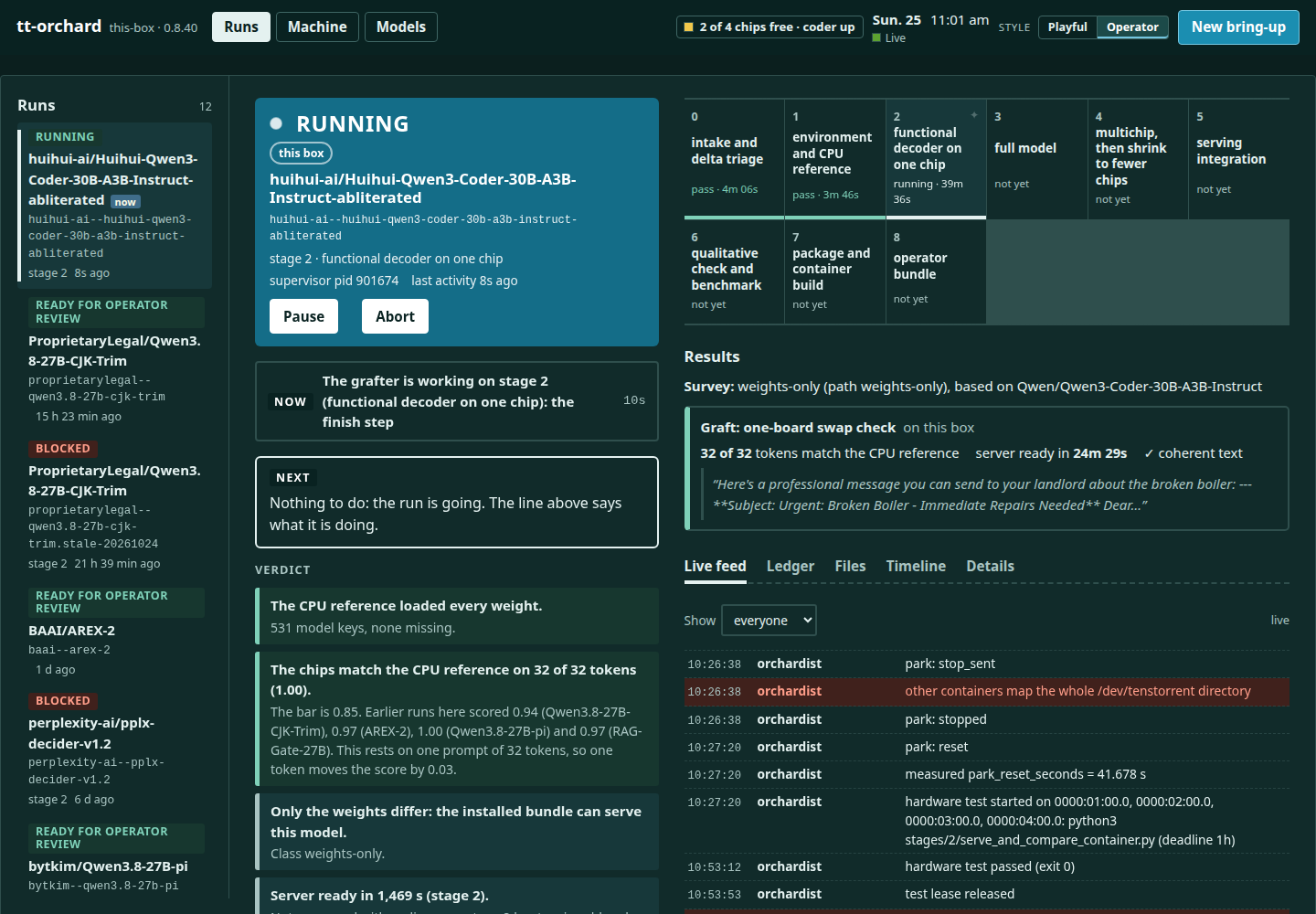
Give tt-orchard a model id. It works out how the model differs from one that already runs on Tenstorrent chips, brings it up on the board, checks the output against a CPU, and stops at a bundle for a person to review. Below is a real run, replayed from its ledger.
The coder model (the agent that writes the tests) holds the first board.
The run is ProprietaryLegal/Qwen3.8-27B-CJK-Trim, a Qwen3.8-27B with 66,533 vocabulary rows removed. The replay is its own ledger, 47 minutes of it, with host paths removed. Nothing here is mocked. The 4-chip test failed at startup and was retried after a reset: that is in the log too.
Stage 0 reads the model before it touches a chip
Every model is sorted from its headers
Stage 0 compares a model's config and weight headers with the nearest model that already runs, downloads no weights, and names a class: weights-only, weights+sidecar, vocab-trim, restricted-head, stock-runtime, full-port or unknown. Audio models take a separate path. The README lists the classes, and the stories below show what several of them led to.
The control page, as it is
Pick a run. See what it is doing and what to do next.
tt-orchard ui is a page on the machine itself. These are screenshots of the real page, taken against real runs: one running as this site was written, one finished, one blocked. Two styles: the farm view and the operator view.
Where the time goes
47 minutes, half of it in the chip tests
The same run, by stage. About half of it is stage 4, the two-chip and four-chip serve-and-compare tests, which build a tensor cache on first boot. Stages that do not apply to a weights-only model are skipped, and the ledger says why.
Measured against its base, on the same chips
A fine-tune and its base, six benchmarks
bytkim/Qwen3.8-27B-pi against Qwen/Qwen3.8-27B: same bundle, same server, same prompts, 9.8 hours of chip time. Bars are the fraction of items passed.
fine-tunebase
Read the GSM8K bar with care. The GSM8K lead is mostly a measuring artefact: the harness's stop string cuts thinking models off, and the base was cut off more often. On the answered items both models score about 0.97. The other five are within noise or a small lead. The log says this in full.
What we brought up, in the order of what each model taught the tool
From a harness built around one model to a 35-line patch
The first models each needed a large piece of new harness work to get past a stop. The later ones needed small changes, because the earlier work was already there. Each story gives what stopped the model, what was built or changed, the measured result with its limits, and what the next model got because of it. Pull request sizes are added lines including tests. Every figure comes from the run log linked under each story.
1
Altworld/Hemmingway-1
the supervisor itself
A creative-writing fine-tune of Qwen3.8-27B, weights only. 2 to 4 October.
What stopped it
Run 1 and run 2 stopped at the coder: the reply was empty because the reasoning used the whole token budget, and two 4-chip packages answered with noise. Agent steps then failed on cut-off and empty replies and looped in thinking mode. Stage 2 had no recipe for swapping weights into an installed package, and the agent spent 60 turns reading source and wrote no test.
What we built or changed
A known-answer check on the coder at first boot (7 times 6 must give 42). A retry for cut-off and empty replies, and thinking off for agent turns. A weights-swap skill, then tested template scripts for stages 2 and 4 that the agent configures with a small JSON file. Two watchdog detectors: no file written in 20 turns, and the same calls three turns in a row. Stage 4 runs one test per chip count, and stage 7 packages the result. The 4-chip noise was a stale tensor cache, found by moving it aside. The test suite grew from 1,141 to 1,600 tests during the run. The first hand prototype had served the base model, and the run log corrects that.
Result
Ready for operator review about 13 hours after the third launch. The harness's own stage 2 test agreed with the CPU on 30 of 32 tokens, with the server ready in 728 s on a cold cache. 1, 2 and 4 chips agreed on 31, 30 and 29 of 32. The 2-chip package passed its boot check (ready in 2,034 s cold). 2-chip and 1-chip packages are published, and the 2-chip one was pulled and booted from the Hub.
What the next model got
The next model, iapp/openthai2.0-qwen3.8-27b, still stopped twice at stage 0 because stages 0 and 1 had no template. After they got one, stages 0 to 7 needed no intervention. The three that remained were at stage 8, which had no template either.
A Qwen3.8-27B post-train with a separate task head (a sidecar of 122 tensors). 6 to 7 October.
What stopped it
Stage 1 wrote files at paths the tool read as nested, then ran pip install --upgrade into the machine's shared Python environment. Stage 2 failed three times: two prepare scripts used one directory, the nearest bundle's speculative drafter needs mtp.* tensors that Clef does not have, and with the drafter off the bundle asked for on-device sampling that a 1x2 mesh refuses.
What we built or changed
A path that starts with stages/ is run-relative. The runner refuses pip installs outside the run directory, and stage 1 gets its own reference interpreter. Separate model directories for the two scripts, and a test that runs both in one directory. For a model with no mtp.* tensors the drafter and device sampling are switched off, and stage 0 records the counts. Testing a fix by hand in a scratch stage directory under its own lease was faster than another supervised attempt.
Result
Ready after 11,092 s of ledger time, with two blocks on the way. 31 of 32 tokens at 1 and 2 chips, 30 of 32 at 4 chips, and sidecar parity of 15 of 16 answers. The 4-chip test parked and restored the real coder. After the run, stage 7 learned the no-mtp.* case. episod/clef-p300 is public, and was pulled and booted from the Hub in 2,540 s.
What the next model got
A model without mtp.* tensors now takes the drafter-off path with no help, and the package ships the evidence its card cites.
A Qwen3.8-27B fine-tune that decides whether to answer or retrieve. 13 to 14 October.
What stopped it
The first run with base-model research chose the bundle and the class on its own. Then the box stopped it three times: the CPU stand-in (ollama) was down when the coder was parked, disk was 0.4 GB short, and the 4-chip test timed out twice at fabric start. All four chips reset under one lease cleared it. A day later a system downgrade of the SFPI compiler made host boots of the bundle fail.
What we built or changed
A preflight row for the CPU stand-in and one for the SFPI version, --auto-retries for blocks that clear on their own, --prune-caches for disk, and a reset of leased chips before a multi-board test. These were written as precautions from three observations and had not yet changed a real run's outcome when they merged. Stage 7 also failed on this machine's shared blob store layout and was fixed.
Result
Stage 2 took 27 minutes 29 s, 31 of 32 tokens. A labelled gate set gave 0.930 on 200 items, and 25 of 25 labels equal the CPU's. episod/rag-gate-27b-p300 is public and was pulled and booted from the Hub.
What the next model got
Each of these stops became a check that fires before anything starts, with a message that says what to do.
It ended ready after six launches of the same command. The new CPU row stopped the first one before anything started. A cache entry that held only config.json and the README counted as a local copy, so 59 GB of weights were never fetched, stage 0 compared an empty model and called it a full port, and stage 1 failed four times. Disk was short twice. The 4-chip test hit the fabric timeout again; the cause is still not isolated.
What we built or changed
A snapshot is local only when a weight file exists behind its link. A retry that has to fetch weights sets the old run directory aside. A multi-board test that fails within 180 s is reset and run once more; that retry did not fire in the final attempt, so it has not run on real hardware. Benchmark tooling followed: a base control built from the model's own run.sh, and stop-string handling.
Result
Stage 2 agreed on 32 of 32 tokens (ready in 682 s). 2 chips 1.0 and 4 chips 0.969. Benchmarked against its base at full size on the same chips in 9.8 hours (see "Measured" above). episod/qwen3.8-27b-pi-p300 is public and was pulled and booted from the Hub.
What the next model got
The same benchmark code later measured CJK-Trim against its base. The benchmark now flags replies that are cut off inside the reasoning, because the GSM8K stop string cut thinking models off.
A Qwen3.8-27B fine-tune with no mtp.* tensors and no generation config. 21 to 26 October.
What stopped it
No generation config stopped stage 2 until the harness learned to copy the nearest model's. With no mtp.* tensors the drafter had to stay off, which left decode at about 17 to 20 tok/s.
What we built or changed
By hand, the nearest model's 15 mtp.* tensors were added as one more shard. Then the harness got the mechanism: stage 0 records a graft candidate, stages 2, 4 and 7 check shapes, dtype and a hash, and stage 2 serves the graft once beside the safe configuration and keeps it only if agreement stays within 0.05 and decode is at least 1.25 times as fast. The two pull requests were 2,172 and 3,131 added lines including tests. The thresholds come from one observation.
Result
Graft against no graft on the same four prompts: 50.05 against 16.95 tok/s (2.95 times), 31 of 32 tokens, and 0.943 against 0.947 on the first 300 GSM8K items. Drafter acceptance was 0.479 on those prompts and 0.644 on tool-calling items. episod/arex-2-p300 is public with the drafter off, and was pulled and booted from the Hub. The supervisor's automatic trial has not run on hardware.
What the next model got
The sampling probe built next found that the drafter applies sampling only to the first token (a sampled reply equalled the greedy reply). Stage 2 now chooses drafter on or off by measurement and by what the model is for.
The nearest model with 66,533 vocabulary rows removed. 24 to 27 October.
What stopped it
Stage 0 called it a full port because the embedding and output matrices are smaller (181,760 rows against 248,320), and the unattended run blocked after stage 1. By hand, three boots showed the rest: the base config's vocabulary size fails at load, the model's own size then fails in the drafter's warm-up (it embeds ids of the base vocabulary), and with the drafter off and host sampling the server was ready in 190 s with 30 of 32 tokens equal to the CPU.
What we built or changed
A vocab-trim class. Stage 0 hashes every row of the two matrices and checks that each is, byte for byte, a row of the nearest model (181,760 of 181,760 found, 8 s). The swap script writes the model's vocabulary size and switches the drafter off. The pull request was 1,558 added lines, most of them tests. The operator's request was "I want vocab size models to port easily."
Result
A supervised unattended run reached ready in 2,804 s of ledger time (the replay at the top of this page). Against its base: English and code tokenize identically, CJK text costs 3.8 to 4.6 times the tokens, and in 40 CJK prompts the trim wrote the asked script 0 times (base 32). GSM8K 95 against 94 of 100.
What the next model got
A vocabulary trim now takes the weights-only path: stage 0 verifies the rows, and the swap scripts set the vocabulary size and switch the drafter off.
The agent model that writes and runs the tests. 28 October.
What stopped it
No block. The question was whether a package with a rebuilt decode step could replace the earlier one.
What we built or changed
Nothing in the supervisor. The two packages differ in container name and image, and a test pins that stopping one ignores a running container of the other. The role-fit test passed (50 of 50 turns, 0 of 35 failure replays repeated). The throughput check had three faults, now fixed with tests: a prefix cache answering the second request, a prompt that invited a 3-token reply, and a negative time difference hidden as an empty value. The pull request was 700 added lines.
Result
Decode median 79.3 tok/s over 28 samples (range 42.7 to 107.6), against 38.5 recorded for the earlier package, which was not measured in the same hour. First-token time on long prompts was 20 to 35 percent longer. Four users at once: 171 to 181 tok/s in total. The earlier package stays as the documented fallback.
What the next model got
It became the default coder for later runs, and the earlier package stays as the fallback.
A text-to-audio model: text encoder, diffusion transformer, autoencoder decoder. 28 to 29 October.
What stopped it
The harness assumed a language model behind an installed bundle. An earlier music model (MiniMax-Music3) had been run by hand: its container hung loading cached tensors over about 32 MiB, and a patched mount got it past that. For Stable Audio the first chip run failed the bars with a bfloat16 residual stream (final latent relative error 0.26).
What we built or changed
A chip transformer module, with the residual stream and the outputs added to it in float32 and matrix inputs in bfloat16 (error 0.138, waveform PCC 0.981). An audio stage table: stage 1 makes CPU references, stage 2 runs the chip test under a lease and compares, and stages 3 to 7 are skipped with reasons. A resident runtime with benchmark rules (one discarded run, at least three measured). The first-divergence and noise-floor tools. Then the decoder on the chip, where differential attention has to stay in float32 (a bfloat16 version lost the difference). The pull requests were 4,733 and 1,648 added lines.
Result
All three checkpoints make full clips with both parts on the chip. A 10 s clip takes 0.82 s with small-music (CPU 3.9 to 8.0 s) and 3.8 s with medium (CPU 38.0 s, one sample). The text encoder is still on the host, the supervisor's stage gate has not been run on these models, and nobody listened to the clips. An earlier small-music package is in a private Hub repository; the rebuild for the decoder on the chip is staged locally and not uploaded.
What the next model got
small-sfx and medium needed a second decoder block layout (medium uses sliding windows) and an entry in the planner, and no new stage.
A 1.5B Mamba-2 hybrid: 36 Mamba-2 layers and 4 attention layers. 28 to 29 October.
What stopped it
No ttnn op does the Mamba-2 state update, so bringup stops at nearest-model-missing and the port was driven by hand. The local coder wrote the state-update and readout kernels with the outside helper switched off. A pass on the simulator did not say a kernel runs on the chip, in two ways. The readout kernels passed the simulator 4 of 10 times and compiled 0 of 7 times on tt-lang 1.1.6, because the pinned simulator and that compiler disagree on reduce_sum.
What we built or changed
Small harness changes: the config reader and hazard scan accept dense Granite hybrids (208 lines), new probe ops for the state update and readout, and the probe's hardware phase stopped leasing the coder's board. Then a pinned tt-lang pair: the pinned simulator with the compiler wheel 1.1.10.dev20261026 agree on the chip for 17 of 20 kernels, including every reduction that failed before. The 3 that fail use -(-x // g) after a thread's grid_size. One pin record and a managed venv followed. The model step then lost its ttnn.repeat copies and the decode step was traced.
Result
The model runs on one chip within the bf16 floor of agreement. Untraced, composed ops ran at 22.6 tok/s and the coder's kernels were slower (16.7 and 18.0; 8.45 with both kernels against 26.9 composed in one session). Traced, in a clean session: composed 37.5 tok/s, state and readout kernels 39.3 (4.8 percent higher), compact state and readout kernels 38.8, state kernel alone 37.3. Composed decode takes 26.7 ms per token against a floor of 5.7 ms.
What the next model got
The probe ladder, staged construction and pinned references were built to measure the coder's kernels. On the ladder the coder passed row_sum 6 of 9 and center 1 of 6, and rmsnorm 0 of 3 before the operator stopped it.
A 4B model with multi-latent attention and a dense MLP. One night, 28 to 29 October.
What stopped it
The existing flash multi-latent attention op failed at one key-value head and batch 1: all 110 cores landed on one head and the reduction allows 64. A first-divergence run then located an error at layer 14: ttnn.rms_norm with its default compute config was 3.7 percent off on a row of norm 223. The two-chip path has no batched prefill.
What we built or changed
An explicit 8 by 8 program config for the op, so no new kernel was needed. rms_norm with 32-bit accumulation (0.08 percent off). Two small harness changes: the config reader derives v_head_dim for this model, and the hazard table has a row for multi-latent attention decode. The port is a set of scripts and does not use the supervisor's stages. The whole model first ran about 20 minutes after the start. Decode went from 18.8 to about 34 tok/s by timing each op alone inside a trace and replacing the slow ones.
Result
33.7 tok/s in bfloat16 on one chip (54 percent of the 62.8 tok/s DRAM floor), 39.9 with an 8-bit MLP, 39.2 on two chips. 16 of 16 teacher-forced tokens match the CPU, and perplexity on 767 WikiText-2 tokens is 8.007 against 8.057 in float32. The supervisor was not used. Findings went to issues 213 and 214.
What the next model got
This used the decode floor, hazard scan and first-divergence tools that had been written the day before, and the harness needed two small edits.
A weights-free thin bundle for this model is on the Hub as episod/minicpm3-4b-blackhole. It was benchmarked again and republished on 2026-11-08: decode 33.5 tok/s median (12 runs at a 2,048-token context), prefill 30 to 33 tok/s because the prompt goes through the decode step, and 16 of 16 teacher-forced steps match the float32 CPU reference on the untraced path. The authors' link to the weights' license returned 404 on 2026-10-30, and the card says so.
A 35B mixture-of-experts model with the same layer types as Qwen3-Coder-Next. 29 October.
What stopped it
No block. The question was which ops of the Coder-Next fused bundle apply to this model. tt-orchard fusion-candidates reads the bundle's code without running it. Four ops apply as they are, two apply with a changed constant (router top-k and the sampler scan grid), and one needs new code (the layer boundary, which runs only on four dies). The bundle's loader did not know this checkpoint layout.
What we built or changed
A 35-line patch for the loader (a prefix, split projections and fused experts), applied to a copy bind-mounted over the bundle's code. The image and the coder were not changed. Weights came by range reads of only the needed tensors: 69.3 GB in about 40 minutes, where hf download ran at 4 to 6 MB/s. No kernel was written.
Result
The full 40-layer model served on two dies: 126.8 tok/s median over 5 runs, 29.6 percent of the estimated floor (428 tok/s). The first 8 tokens match the CPU, then a near tie flips (the routed experts are 4-bit). Both changed constants moved decode by 0.1 percent or less, so neither was kept. One prompt, on a shared host. The weights-free recipe package is on the Hub as episod/qwen3.5-35b-a3b-blackhole-p300.
What the next model got
The classification named the op that needs new code before the first boot, and the two changed constants were tested and dropped.
A text-to-music model with a diffusion transformer and a VAE decoder. 29 and 30 October.
What stopped it
Nothing on the chip. A community bundle already ran the transformer and the decoder on a Blackhole chip. The audio route, though, assumed Stable Audio 3: a 44.1 kHz sample rate, its runtime files, and one comparison at the end of the sampler loop. In a sampler loop each step feeds its error into the next, so an end-to-end comparison fails on late steps for a correct chip.
What we built or changed
A per-step check that gives every step the same input and compares it with a bfloat16 CPU run, with a bar of two times that floor and a wrong-step control. An audio profile per model (sample rate, files, arrays). A weights-free package with a small HTTP server. A profile showed that most of a request was on the CPU, so the text and lyric encoders and the cross-attention projection moved to the chip, and two cache and garbage-collection fixes removed repeated work. A cache of links to the model's files made the bundle run different code with no error; the runner and the package now refuse links.
Result
A 30 s clip takes 0.93 s and a 480 s clip 12.3 s on one chip (medians of three runs after a warm-up; the first version took 3.0 s and 14.6 s). The per-step check passes on two prompts. End-to-end agreement with the float32 CPU run is lower after the encoders moved, and the card says why. Nobody has judged the music beyond length and level checks. The package is on the Hub as episod/ace-step-1.5-turbo-blackhole.
What the next model got
The per-step bars and the audio profile apply to any sampler-loop model. The planner language model and the XL transformer are not done.
A 7B hybrid with gated-delta-net layers and attention layers, and no existing port. 7 and 8 November.
What stopped it
Stage 0 called the model class unknown because it shares no tensor name with its nearest model, so the run paused although it had been started with the full-port flag. The first ports made no ttnn matmul call and failed the device-ops gate, and a later one failed on a rope_theta that the config leaves as null. A first server start on four chips hit a fabric handshake timeout.
What we built or changed
A class rule: no shared tensor name plus a difference in the text config is a full port (PR 595). The outside helper wrote the repair rounds, seven calls costing $8.60. The package was written by hand with the canning commands, because stage 7 skips a full-port run: a spec, an ASGI adapter and a card generated from the records.
Result
Stages 0 to 6 and 8 passed. Stage 2 top-1 agreement was 1.0 over 32 tokens, the served port matched an 80-position acceptance corpus, and a passkey was answered at 256 and 8,192 tokens. Served decode is 7.3 tok/s median on four chips with the host loaded (2.2 to 12.3 across runs and boot checks; 13.9 tok/s in the stage 6 harness), and 2,261 tokens of prefill take 22 s. The bundle takes one request at a time. One of four prompts differs from the CPU reference at its second token; the logits show a bf16 near tie that the reference itself resolves differently in its two paths. Published as episod/olmo-hybrid-7b-blackhole. These are single runs, and a person started and restarted the run.
What the next model got
The class rule, the helper's repair loop and a packaging recipe for full-port models. The Qwen3.8-27B-QSA bring-up that followed passed stages 0 to 4 on four chips and ended blocked at stage 5. Serving matched the reference on all 80 corpus positions, and the passkey check failed at both lengths because a thinking model's reply was cut at the answer limit (issue 641). QSA was not exercised: the stage 2 port does not use the indexer tensors and the agreement prompts are shorter than the indexer budget (issue 638).
A LoRA merged into Qwen3-32B that writes CadQuery, weights only. 6 to 8 November.
What stopped it
Stage 2 passed on four chips. Stage 4 stopped with package-missing, because the base bundle has only a four-chip profile. On two chips, eight sequences gave garbled text where 32 gave coherent text (the cause is not known), the base manifest's on-device sampling setting failed at the first decode, and tt-model refused to start on free chips.
What we built or changed
A container package that reuses the base image unchanged and adds a p300 profile (8,192 context, 32 sequences) beside the base p150x4 profile, with sampling on the host. A CadQuery checker that runs each reply in a child process with an empty environment, resource limits and a Landlock sandbox. It has no network namespace, so UDP and Unix sockets are not blocked.
Result
Decode is 14.4 tok/s median on one board (12.1 to 15.0), with a first token after 0.19 s for 133 tokens. 21 of 24 sample replies make a valid CadQuery solid (8 prompts, 3 repeats each, too few to call an evaluation). A cold first boot took 532 s and a warm boot 81 s. Published as episod/berkelium-qwen3-32b-cadquery-p300. The Hub repository carries the base container image, whose own repository states no licence, and the weights' licence is "other" with a non-commercial request on the card.
What the next model got
A recipe for a second profile of a container package. Each profile needs 35 to 45 GB of tensor cache, which filled the root disk during the run.
An unattended run ends in blocked, releases the chips and writes what it tried. The text in each box is quoted from a real run on this machine. Some models stopped on purpose: Nemotron-3.5-Bolt-74B at the preflight (no installed bundle serves its base), and pplx-decider-v1.2 with needs-new-model-code, because its readout head and non-causal attention are described in the card and the code and are absent from the config. A parity run by hand later measured 14 of 14 answers equal to the CPU on the chips.
disk-full
hf_home: needs 202 GB, 116 GB free
From a preflight, before anything downloaded. The block now also lists the largest models and caches on the short disk.
agent-stuck
watchdog: 3 identical responses in a row (18830 input, 186 output tokens)
The agent wrote the same file three times and the watchdog stopped it. The cause was a missing 2-chip package; stage 4 now reports that before any agent runs.
a reference that said pass
The reference's own check failed, but reference.json says pass (evidence/summary.json says fail). 851 of 851 model keys were not found in the checkpoint.
An agent wrote a passing reference over a failed check. The gate now compares the two files, and the page shows the mismatch first, in red.
needs-new-model-code
Needs new model code: class unknown, path full-port. An unattended run stops here; a full port is a person's decision.
When the harness meets an architecture it has not seen, it stops, releases the chips, and says what it found.
Where the tool is now
What is automatic, what still needs a person
The aim is a run that goes from a model id to a reviewed bundle with nobody touching the machine. The harness has never done that end to end. This is where each part stands.
Automatic
The preflight: disk, chip bus, SFPI compiler, the CPU stand-in, credentials, the base model, and whether the tools are current.
Stage 0 sorts the model. For a weights-only fine-tune, a sidecar model or a vocabulary trim the run goes through stages 0, 1, 2, 4 and 8 with no new code. Stages 3, 5 and 6 are skipped by design, and stage 7 packages when asked.
Serving checks at 1, 2 and 4 chips, with a park and restore of the coder when a test needs its board.
Retries for stops that clear on their own, and a stop with a stated reason for the rest.
A down outside helper no longer stops a run: after two failed connections the run goes on without help and probes again every five minutes. On 2026-11-09 the helper's network went away and this was the case that prompted it.
Stage 1 loads a model that ships its own code, after removing credential-like environment variables, going offline and writing the hash of every Python file to an audit file. It is an audit trail and not a sandbox.
A release-day check for a new Qwen release (tt-orchard drop-check, with a watcher, drop-watch) says which route a bring-up takes from the release's config and the bundle's declared capabilities, before any weight file is read. It has been run on a Qwen4-shaped test checkpoint and on fakes. No Qwen4 release exists yet.
For a Qwen4-shaped model, --thin-port has the generator write the whole port (gated delta net, sparse attention, PLE block, hyper-connections, and a MoE block that splits the experts over the chips in bfp4 or bfp8). The tiny Qwen4 MoE rehearsal passes stages 0 to 6 and 8 on 2 and 4 chips this way. tt-orchard plan says how many chips a checkpoint needs before any download, and stage 2 reports a fidelity score, near-tie disagreements and a prefill against decode check next to top-1 agreement.
A review bundle and, on request, a package with its card, checked against its files.
Needs a person or new code
The real Qwen4 size. The generated port has not run at 512 experts per layer on four chips, a generated port decodes by running the whole sequence again until the cached decode (issue 759) merges, and by our estimate the generated port needs about 95 ms per token where upstream's Flash-Next port takes 26 ms (the generated one issues about 9,500 small ops per token). Until then the published ports are the speed reference.
Publishing. The harness never uploads anything.
Any model whose class is full-port or unknown. For class full-port the run pauses before stage 2 unless it was started with the full-port flag. A class unknown still stops for a person. Two full-port models have gone through stages 2 to 6 with an outside helper writing the repairs. A person started and restarted both runs, and the coder alone has not written a passing port.
New code is written by hand with the tools: the op inventory, the kernel probe and its ladder, the decode floor, the hazard scan, the first-divergence probe, the measured noise floor, fusion-candidates, and the pinned tt-lang pair. tt-orchard updates reports when the coder, tt-lang or tt-metal have newer versions.
Disk space, and a restart after a power event, though each now has a preflight row or a block message.
Open edges
The coder's kernels for Granite are 3 to 5 percent faster than composed ops only after the ttnn.repeat copies were removed and decode was traced. Before that they were slower. The readout kernels depend on the tt-lang version, and the coder passes the simulator on easy ops and fails rmsnorm.
MiniCPM3-4B and Granite-4.0-H-1B were driven by hand and did not go through the supervisor. MiniCPM3 has no batched prefill on two chips.
A full-port model is packaged by hand, because stage 7 builds a package only on the weights-only path. Served speeds for Olmo-Hybrid-7B ran from 2.2 to 12.3 tok/s with the host's load, and its bundle takes one request at a time.
Stable Audio 3 has its text encoder on the host, and nobody listened to the clips. Agreement is measured against a CPU reference on a single prompt or a small set.
Qwen3.8-27B-QSA passed stages 0 to 4 on four chips and its serving matched the reference on 80 of 80 corpus positions, then stopped at stage 5 because a thinking model's passkey replies were cut at the answer limit (fixed in PR 652). The port does not use the sparse-attention indexer tensors, and every agreement prompt is shorter than the indexer's 2,048-token budget, so the indexer was not shown working (issue 638).
The coder alone has not written a passing full-port stage 2 port. An audition of another Qwen3.8-27B bundle as the coder against Qwen3-Coder-Next is under way (issue 510); no results are claimed here.
The automatic graft trial has not run on hardware. The 4-chip fabric timeout seen in three runs was cleared by a reset each time, and its cause was never isolated.
Speeds are medians on a shared host. The Granite, MiniCPM3, Qwen3.5-35B-A3B and ACE-Step packages are published; their numbers are in their cards.
On a QuietBox 2 the setup script (run it after --check) checks each prerequisite, installs tt-gozer (the chip lease manager) when it is missing, and writes the machine config. It never resets a chip, takes a lease or publishes anything.
$git clone https://github.com/tsingletaryTT/tt-orchard.git && cd tt-orchard